 Scavenger Hunt App & Interactive City Tours | Globe Chaser

The easiest way for a team-building scavenger hunt to lose half the team is to let one person hold the phone, read every clue, choose every answer, and navigate the entire route. The fix is simple: give people clear jobs and rotate them.
Roles do not need to feel formal. They are just a design tool that gives each participant a reason to contribute. A five-person team can use the system below from the first checkpoint to the finish.
Five useful scavenger hunt roles
| Role | Main job | What to avoid |
|---|---|---|
| Clue reader | Reads the full prompt aloud and makes sure the team understands the task. | Solving the clue before anyone else has heard it. |
| Observer | Studies the surroundings and points out relevant details. | Walking away from the group to search alone. |
| Navigator | Helps the team identify the next approved direction or checkpoint. | Treating speed as more important than the group staying together. |
| Recorder | Enters the agreed answer or handles the photo task. | Submitting before the team confirms the response. |
| Timekeeper | Tracks the session plan and reminds the team when it is time to move on. | Pressuring teammates over a few seconds. |
For most teams, the timekeeper can also watch for the next rotation. If your event has a separate captain, make that person responsible for group communication rather than giving them every decision.
Rotate at every checkpoint
Rotation is what makes the role system work. After each completed task, everyone moves to the next role. By the fifth checkpoint, every player has tried every job once.
For a longer event, repeat the cycle. For a short three-stop hunt, combine recorder and timekeeper, then rotate three broader roles: reader, observer, and navigator/recorder.

Design tasks that need more than one role
Observation plus interpretation
The observer finds three symbols on a landmark. The clue reader explains the question. The team decides which symbol answers it, and the recorder submits only after everyone agrees.
Split-information puzzle
Give the team two facts in the prompt and require them to find a third fact at the location. Nobody has the full solution without combining information.
Creative photo challenge
The team must create a photo around a theme such as “balance,” “connection,” or “opposites.” One person handles the camera, but the others decide the concept and composition.
Direction choice
At a junction, players compare two visible landmarks and use a clue to determine which way to continue. The navigator manages movement, but the observer and clue reader supply the evidence.
Final explanation
Instead of asking only for a word, ask the team to explain briefly how they know. This turns a lucky guess into a shared reasoning task.
Adjust the system to team size
- Three people: reader, observer, navigator/recorder.
- Four people: reader, observer, navigator, recorder/timekeeper.
- Five people: use all five roles.
- Six or seven people: add a second observer or a discussion leader who makes sure everyone speaks before submission.
If a participant prefers not to take photos or use the device, give them another equivalent role. The goal is contribution, not forcing every person into the same activity.
Use Globe Chaser to support the structure
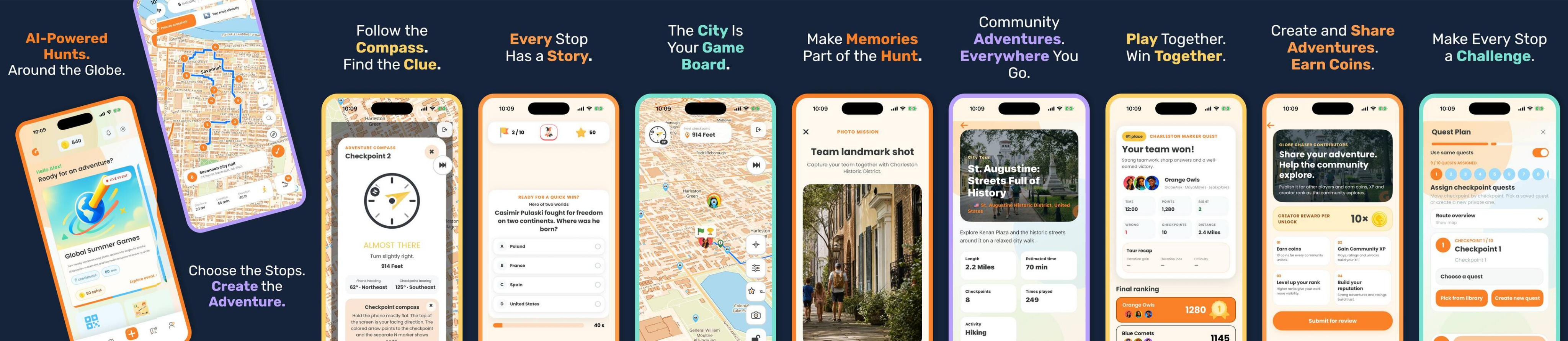
Globe Chaser combines routes, checkpoints, quests, photo tasks, scores, and team progress for outdoor team-building events. The technology organizes the event, but the role system makes the human side more intentional.
Our guide to choosing a scavenger hunt app for outdoor team building explains what to test before the full event. If you are planning a company outing, the Globe Chaser team-building overview shows the available options for corporate groups and event organizers.
Debrief the roles, not only the score
At the finish, ask each team which role was easiest, which was hardest, and which teammate helped them most. That conversation gives you more useful team-building material than simply announcing first place.
A scavenger hunt becomes more collaborative when participation is designed into the rules. Give every player a job, rotate the jobs often, and write challenges that make those roles matter.