 Scavenger Hunt App & Interactive City Tours | Globe Chaser

A good school field trip should give students something to notice, discuss, and remember—not just a place to walk through. One simple way to make that happen is to turn the outing into an outdoor learning mission with checkpoints, observation tasks, and a short reflection at the end.
Globe Chaser can help teachers and trip leaders structure the experience without burying students in worksheets. The phone or tablet becomes the guide, while the real destination remains the focus.
Start with one learning goal
Before you build the route, decide what students should notice or practice. A field trip works better when the missions support the destination rather than compete with it.
- At a nature center: identify patterns, habitats, or species signs.
- At a historic district: compare architecture, dates, symbols, or public markers.
- At a museum campus: find visual details before discussing the exhibit.
- At a civic location: connect buildings and public spaces to classroom topics.
Build five checkpoints, not twenty
Students do not need a task every few steps. Five well-designed checkpoints can create a stronger experience than a long list of repetitive questions.
| Checkpoint | Purpose | Example |
|---|---|---|
| 1 | Orient the group | Identify the main landmark and one visible feature. |
| 2 | Observe closely | Find three details related to the lesson topic. |
| 3 | Compare | Choose which of two features better matches a prompt and explain why. |
| 4 | Create | Take a team photo or record a short answer based on the location. |
| 5 | Reflect | Choose one thing the team noticed that it had not expected. |

Give students simple team roles
One device can become a problem if one student controls it for the entire trip. Assign short rotating roles instead: reader, navigator, observer, recorder, and timekeeper. Rotate at each checkpoint so that every student contributes.
For younger groups, combine roles and keep instructions short. For older students, add a discussion role such as “evidence checker,” whose job is to ask, “What did we actually see that supports this answer?”
Use the destination as the clue sheet
A school outing becomes more engaging when students have to look at the place itself. Use signs, textures, public art, plant features, architecture, maps, plaques, and visible patterns rather than hiding objects or placing props around the route.
This approach also keeps setup simpler. Our guide to building a scavenger hunt without hiding anything includes ideas you can adapt to educational outings.
Keep the pace realistic
Do not turn the field trip into a race. Build in time for walking, regrouping, restroom stops, accessibility needs, and normal delays. If the site is busy, choose checkpoints that can be completed from wide public areas without blocking others.
A 45- to 60-minute activity might use 5–7 minutes for briefing, 25–35 minutes for the mission, and 8–10 minutes for a closing discussion.
End with a two-question debrief
The best learning moment often happens after the route. Keep the debrief simple: “What did you notice today that you would have missed on a normal walk?” and “Which checkpoint made your team think the hardest?”
Those questions turn the activity back toward observation and learning instead of only scores.
Where Globe Chaser fits
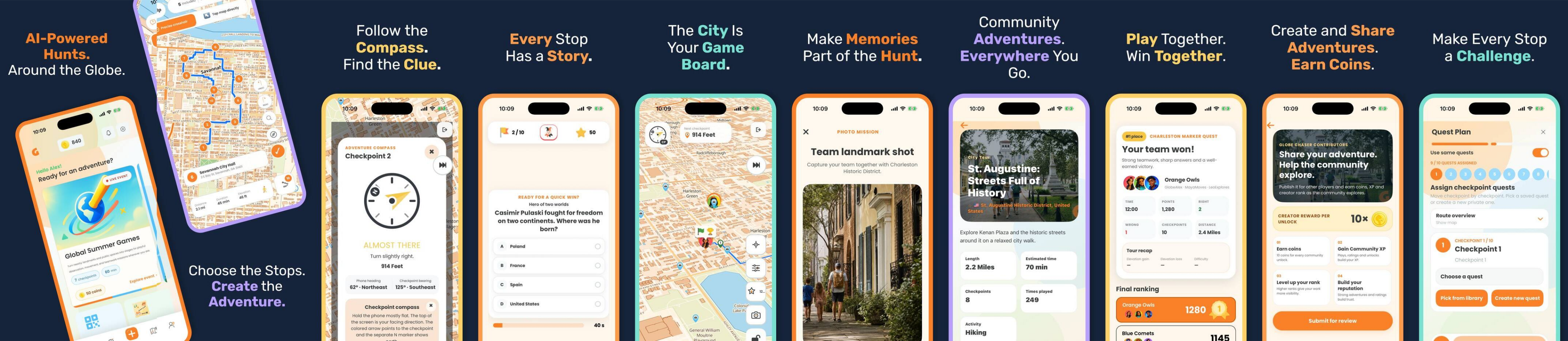
Globe Chaser lets educators turn a real location into a guided sequence of checkpoints, questions, and photo missions. That can work for school field trips, camp outings, nature walks, history visits, and other off-campus learning days.
For more school-focused options, explore the Globe Chaser education overview and build the activity around the place you are already planning to visit.