 Scavenger Hunt App & Interactive City Tours | Globe Chaser


You do not need hidden envelopes, planted props, or objects tucked behind benches to run a good scavenger hunt. A strong route can use what is already there: signs, colors, dates, shapes, public art, architecture, sounds, viewpoints, and small details people normally walk past.
This format is especially useful in parks, downtown areas, campuses, and neighborhoods because setup is lighter and cleanup is almost nonexistent. It also fits naturally with a digital hunt: the location becomes the game board, while the phone delivers the prompt and records the answer.
Why a no-hide scavenger hunt works so well
Hidden objects create extra work. Someone has to place them, make sure they stay in position, replace anything that disappears, and remove everything afterward. In a busy public space, a physical clue can also be moved, mistaken for litter, or picked up by someone who is not playing.
A no-hide hunt changes the question from “What can I place here?” to “What can players notice here?” That usually produces better exploration. Instead of looking for a paper clue, players start examining the actual place.
15 challenge types that use what is already around you
- Count a repeated detail. “How many blue panels are visible on this side of the building?”
- Find a color. Ask teams to identify three different objects that match a chosen color without moving anything.
- Spot a shape. Look for circles, triangles, arches, spirals, or repeated geometric patterns.
- Read a public sign. Ask for one word, symbol, or piece of information visible on an official sign.
- Find a year or date. Historic plaques, cornerstones, memorials, and public displays often provide a clear observation task.
- Compare textures. Ask which of two visible surfaces looks smoother, rougher, older, or more reflective.
- Inspect public art. Choose one mural, sculpture, or installation and ask about a specific visual detail.
- Match a viewpoint. Give players a photo or description and ask them to stand where the scene makes sense.
- Hunt for letters. Find a sign or building name containing a certain letter combination.
- Find symmetry. Ask teams to identify a feature with matching left and right sides.
- Listen for a sound. At a safe stopping point, ask players to name two distinct sounds they can hear.
- Frame a photo. Create a photo challenge around a landmark, tree canopy, mural, fountain, or other verified feature.
- Choose the next direction. Use a visible landmark as the decision point: “Walk toward the clock tower, not the parking garage.”
- Compare two nearby features. Which doorway is taller? Which sign has more words? Which tree has the wider trunk?
- Describe without naming. One teammate describes a visible object while the others identify it.

Turn the ideas into a five-stop mini adventure
You do not need to use all 15 challenge types at once. A short route feels stronger when every stop does something different.
| Stop | Challenge type | Example |
|---|---|---|
| 1 | Public art | Find the mural and name the largest repeated shape. |
| 2 | Sign detail | Read the public sign and enter the final word in its heading. |
| 3 | Count | Count the visible arches on the front of the building. |
| 4 | Team description | One player describes a nearby landmark without saying its name. |
| 5 | Photo | Take a team photo that includes the finish landmark without blocking the walkway. |
Turn the surroundings into your game board with Globe Chaser
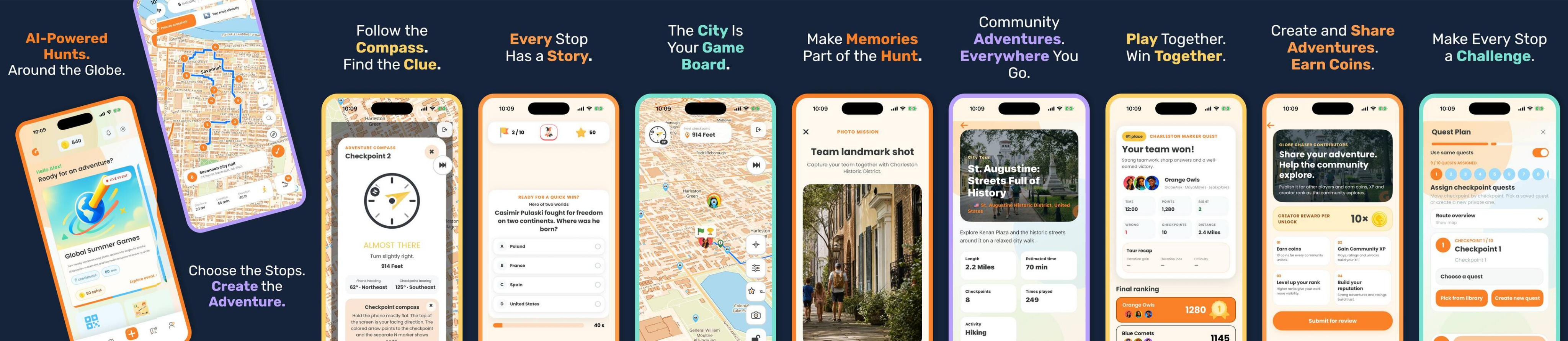
With Globe Chaser, you can build location-based adventures around checkpoints, quests, questions, and photo tasks. That makes the no-hide approach a natural fit: the physical environment supplies the clues, while the app supplies the structure.
If you want more ideas for urban exploration, see our guide on using a scavenger hunt app to explore a new city. For creative image-based tasks, the photo scavenger hunt guide is a useful companion.
Test every clue from the exact place players will stand
A detail that seems obvious while you are designing the hunt may be hidden by a parked vehicle, seasonal decoration, construction barrier, or tree branch on event day. Walk the full route and answer every question yourself. Check that the clue can be solved without stepping into traffic, entering private property, touching objects, or blocking other people.
A good no-hide scavenger hunt leaves the place exactly as it found it. Build the challenge around observation, not interference.
Start with five reliable public details near you, turn each one into a different kind of challenge, and test the route on foot. When you are ready to move beyond paper clue sheets, build the experience in Globe Chaser and let the surroundings do the hiding for you.