 Scavenger Hunt App & Interactive City Tours | Globe Chaser

Should your next city outing be a guided walk, a self-guided tour, or a scavenger hunt? The best choice depends on what you want to do once you arrive: listen to an expert, follow information at your own pace, or work together to notice, solve, and explore.
A walking tour can give you live interpretation and a clear story. A self-guided walk leaves room for detours. A scavenger hunt adds a job at each stop, turning landmarks, public art, streets, and local details into checkpoints, questions, quests, and photo challenges.
Quick answer: which city adventure fits your group?
| If you want to… | Best fit | Why |
|---|---|---|
| Ask questions and hear local context | Human-guided walking tour | A guide can explain the place and respond in real time. |
| Explore independently with an established route | Self-guided informational walk | You control the pace and can pause or take a detour. |
| Give everyone something active to do | App scavenger hunt | The route combines movement with observation, solving, and shared decisions. |
| Build an outing around a specific location | Custom scavenger hunt | You can choose checkpoints, prompts, quests, and photo missions for your group. |
These are format differences, not guarantees. One tour may be lively and interactive while another is mostly lecture-based. One scavenger hunt may be competitive while another is cooperative. Check the activity details before you commit.
What makes a scavenger hunt different?
A walking tour usually asks you to pay attention to the guide. A scavenger hunt asks you to interact with the place itself. Instead of only hearing that a building matters, your group might find a visible architectural detail, compare two public artworks, answer a location-based question, or take a team photo that shows you reached the checkpoint.
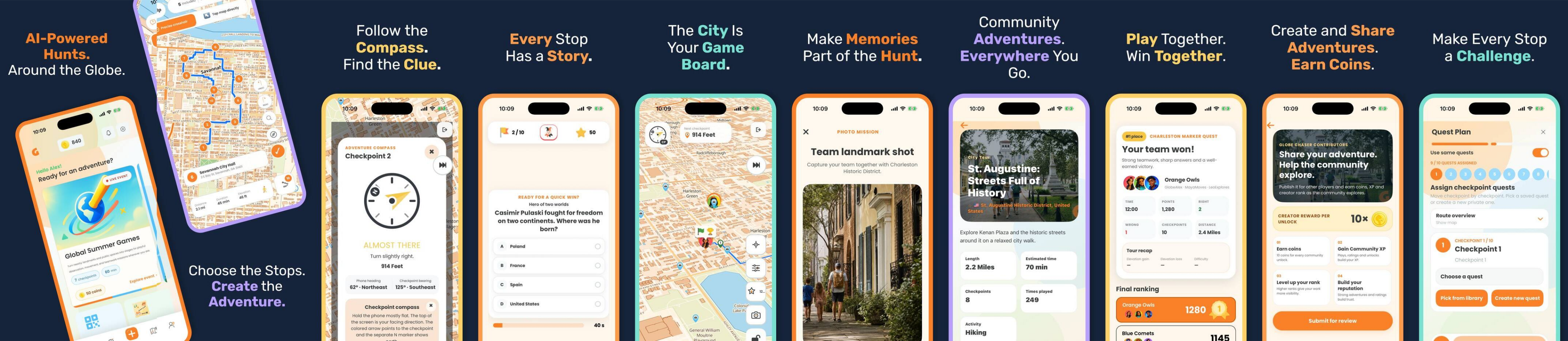
Globe Chaser is designed around that active format. Its app supports city adventures with GPS checkpoints, quests, questions, photo challenges, and interactive 2D and 3D maps. Routes can be created for walking or cycling, and organizers can manually build adventures around a particular location or audience.
The distinction matters: Globe Chaser is not a human tour guide and is not simply a turn-by-turn navigation app. It provides the adventure structure; your group supplies the conversation, observation, and decisions along the way.
Choose by the people coming along
Families who need a reason to keep looking
Families often have mixed interests. One person wants to see the landmark, another wants to take photos, and someone else is ready to move on. A scavenger hunt gives the group a shared task without requiring everyone to enjoy the same kind of sightseeing.
Choose short distances, visible checkpoints, and prompts that can be answered in more than one way. For example, ask children to find a repeated shape on a building, identify a color in a mural, or choose which detail they would use as a city symbol. Keep the route realistic for the youngest or least mobile participant.
For additional planning ideas, see our family scavenger hunt planning guide.

Travelers who want structure without a fixed group
A self-guided scavenger hunt can be a useful middle ground between booking a tour and wandering without a plan. You can follow a route when you want direction, pause for food or photos, and continue when the group is ready.
This format works especially well when you want to see a city through a theme. Build the outing around public art, historic details, waterfront views, architecture, neighborhood stories, or a photo-based mission. The route gives the day shape without requiring a guide to stay with you.
Schools, camps, and scouts
For an educational outing, design each checkpoint around one clear learning goal. Students might compare building materials, locate evidence on a public sign, identify patterns in nature, or explain an observation in their own words.
Globe Chaser supports organizer-created adventures, so the activity can be tied to the place you are already visiting. Keep the route manageable, rotate roles such as navigator and observer, and leave time for regrouping and discussion.
Friends and teams who want participation
Choose a scavenger hunt when the group will enjoy making decisions together. A good route does not need to reward only the fastest walkers. Mix observation, navigation, creative photo tasks, and questions that require the team to agree on an answer.
For a larger event, plan the route so teams do not crowd the same checkpoint. Consider different starting points, staggered departures, or routes that run in opposite directions. The goal is a shared challenge, not a traffic jam in front of one landmark.
Match the format to the city day
Choose a human-guided walking tour when context is the priority
A live guide is the strongest fit when you want interpretation, historical background, and the ability to ask follow-up questions. This can be especially useful for a first visit, a specialized subject, or a group that prefers listening to solving.
Before booking, check the meeting point, duration, terrain, group size, and subject. A walking tour may cover more ground than expected, and the guide’s pace will shape the experience.
Choose a self-guided walk when independence matters most
A self-guided informational walk gives you control over timing. You can linger at a favorite stop, skip a crowded area, or take a longer break without holding up a group.
You will also manage the route, timing, and research yourself. Save the key information before setting out, confirm opening hours where relevant, and choose a finish point with a convenient place to rest.
Choose an app scavenger hunt when the group should do more than look
An app scavenger hunt is a strong fit when you want the city to become a game board. You can explore an existing adventure or create your own route with checkpoints, questions, quests, and photo missions.
For example, a downtown route might ask teams to:
- Find a visible symbol repeated on two nearby buildings.
- Use a map checkpoint to reach a public-art stop.
- Answer a question using information on an official plaque.
- Take a photo that shows a geometric shape in the streetscape.
- Choose between two possible routes and explain the decision.
The activity remains flexible. You can walk, cycle, solve every prompt, or treat the quests as optional layers over a broader city outing.
Use this five-minute decision test
Before choosing an activity, answer these questions:
- What should participants be doing? If the answer is mostly listening, choose a guided tour. If it is looking, deciding, and solving, choose a scavenger hunt.
- Who controls the pace? A guide controls the group rhythm. A self-guided walk gives you more freedom. An app hunt adds structure while allowing your group to move independently.
- How much preparation do you want? A booked tour reduces planning. A self-guided walk requires route research. A custom hunt requires you to choose checkpoints and prompts, but the format can be adapted for future groups.
- What should the finish feel like? A tour may end with questions and recommendations. A self-guided walk can finish at a café or viewpoint. A scavenger hunt can end with a final quest, photo review, or short team debrief.
- What does the route require? Check distance, surfaces, weather, traffic, rest points, opening hours, and accessibility before you start.
The bottom line
Choose a human-guided walking tour when expert interpretation is the main reason for the outing. Choose a self-guided walk when you want independence and room for detours. Choose a scavenger hunt when everyone should have a role in discovering the city.
Globe Chaser fits the third option: an active, location-based adventure with checkpoints, maps, quests, questions, and photo challenges. Whether you use a ready-made route or create your own, the app provides the structure while your group turns the city into the experience.
Ready to explore at your own pace? Explore the Globe Chaser app and choose an adventure that matches your group, route, and city-day goals.