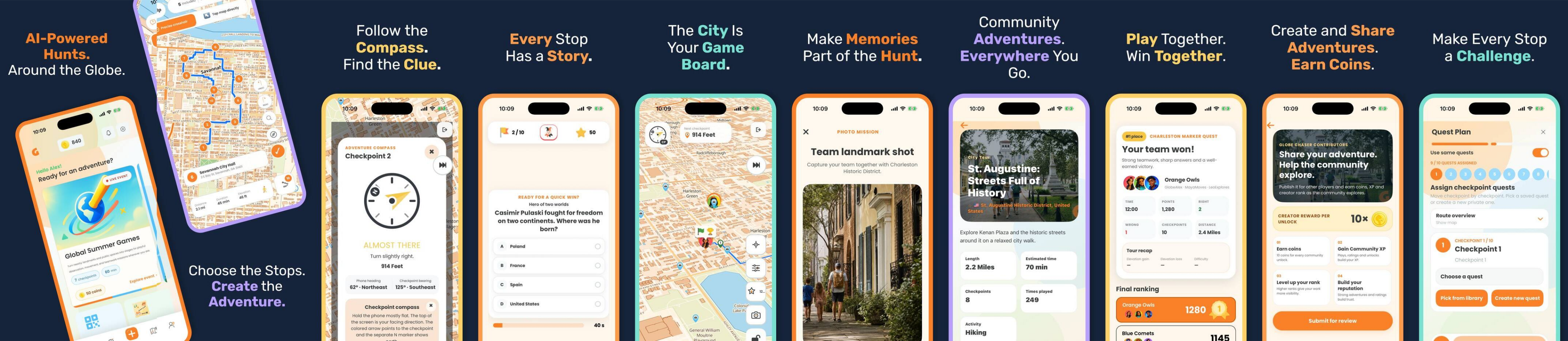
 Scavenger Hunt App & Interactive City Tours | Globe Chaser

Run a multilingual scavenger hunt by making tasks visual, translating the same meaning into each group language, and giving teams ways to solve together. Build around things participants can see, count, match, or photograph, and brief everyone on safety. Globe Chaser arranges the route with checkpoints, quests, and photo challenges; you check the wording before the group arrives.
Start with a shared experience, not a vocabulary test
A good multilingual hunt rewards attention and teamwork. It should not require idioms, narrow cultural references, or conversations with shop staff. Choose public features such as colors, shapes, murals, building details, plaques, and patterns. If a clue includes a local name, show it as it appears on the sign and add a visual reference.
Use short sentences with one action each. “Find the green arch. Count its lamps. Note the number” is easier to translate and act on than a playful paragraph full of wordplay. Keep answer choices parallel, and avoid slang, puns, abbreviations, and instructions that depend on tone. W3C’s writing guidance recommends clear instructions and concise, simple language. Those principles are useful for your source text before translation.
For a route-building refresher, how to plan a scavenger hunt for a large group offers useful logistics to adapt for your languages and team size.
Build language equity into each checkpoint
Draft the source prompt, then make a separate version for every language represented in the group. Have a fluent reader compare each version with the source for meaning, action, and answer options. Check that measurements and directions stay equivalent.
| Checkpoint element | What to standardize | Helpful design choice |
|---|---|---|
| Direction | Starting point and turn | Pair text with a landmark photo or shape |
| Observation | Object participants must inspect | Name color, position, and count |
| Answer | Accepted response | Use matching images, numbers, or short labels |
| Photo challenge | What the camera should show | Frame an object or scene without people |
| Finish | How teams know they are done | Repeat the finish landmark in every version |
Ask reviewers to complete the task, not just proofread it. If a translation changes a direction, fix it before publishing. Have someone who did not write the clue follow it using only that version.
Use Globe Chaser as a shared route guide
Organize the experience as outdoor checkpoints. Write a short title recognizable in every language, then place the translated task text where participants will read it. A quest can match a shape or count features; a photo challenge can capture an architectural detail. Ava can help build multilingual quests, but your team should verify every version on the device participants will use.
Give mixed-language teams roles that rotate: navigator, detail spotter, reader, photographer, and answer checker. Participants can point, compare the scene, and confirm answers together. Agree on who operates the team’s device and rotate that role where practical. Print a one-page safety briefing in the group’s languages.
Before the event, check that every team can open its intended language version and understands how to answer. Avoid placing the whole translation burden on one bilingual teammate; that person should have time to play too.
Brief the group before the first turn
Use simple spoken language, gestures, and a visual route preview. Demonstrate a sample task, including its answer format and a suitable photo. Explain where the group may walk, how teams stay together, and what to do if a checkpoint is crowded.
Translate the safety points with the same care as the game clues. Cover traffic crossings, private property, respectful photography, weather, and the meeting point. Ask each team to point to the finish on the route overview before spreading out.

A worked 60-minute format
Imagine a museum exchange group divided into six mixed-language teams. Use a sample budget of 8 minutes for briefing, 20 for walking, 20 for five checkpoint tasks, 5 for breaks or delays, and 7 for the finish. That totals 60 minutes; test it with the languages and group pace you expect.
- Checkpoint 1, public sculpture: Match three visible shapes to a simple image key.
- Checkpoint 2, tiled wall: Count the repeated circles and note the number.
- Checkpoint 3, park path: Photograph a bench detail from the path, with no faces in frame.
- Checkpoint 4, historic doorway: Compare two posted numbers and choose the one shown on the clue card.
- Checkpoint 5, meeting fountain: Confirm the finish landmark and share one observation from the earlier stops with the host.
Ask one reviewer per language to walk the route. The host should carry the route overview, know the nearest regrouping point, and explain a clue without giving away its answer.
Solve the predictable friction points
If participants read at different speeds, use fewer words and more visual anchors. If a landmark is hard to recognize, add a distinctive feature and a direction from the previous checkpoint. If a team misses a turn, have it stop in a safe place and contact the host for directions. Check where it is in the adventure before deciding how to continue.
After the hunt, ask one question in each language: “Which clue was hardest to understand?” Record the wording that caused trouble, revise it, and rerun that checkpoint with a colleague. Also ask whether everyone had a chance to navigate, observe, and answer. A correct final score can hide an experience dominated by the fastest reader.
Choose Globe Chaser for a shared outdoor scavenger hunt that brings an international group together around places and puzzles. Explore the app and Ava’s multilingual quest creation, then review the language versions with people who will understand your audience.