 Scavenger Hunt App & Interactive City Tours | Globe Chaser

A fall festival scavenger hunt should make the event feel richer, not give vendors another job. The best version uses things that are already visible—pumpkins, banners, public art, signs, seasonal displays, stages, buildings, and landmarks—so participants explore the festival without interrupting booths or hunting for hidden props.
That makes the format useful for downtown events, nonprofit festivals, school fairs, farmers markets, and community celebrations. Build the hunt around the event layout, not on top of it.
Start with one rule: do not create work for every booth
A vendor should not have to answer the same scavenger-hunt question 200 times unless they have explicitly agreed to be part of the activity. Avoid tasks that require participants to ask for a code word, handle merchandise, make a purchase, enter a crowded stall, or wait in a line simply to complete the hunt.
Instead, make most checkpoints self-contained. Participants can observe a visible sign, count decorations, identify a color, answer a local-history question, or photograph a public feature from an appropriate distance.
Eight fall-festival checkpoint ideas
- Pumpkin pattern: find a public display and count how many different pumpkin colors are visible.
- Festival banner: identify one word, date, or symbol printed on the main event banner.
- Autumn color hunt: find three different shades associated with fall and name where you saw them.
- Market observation: identify three seasonal products visible from the public aisle without touching merchandise.
- Public art stop: find a mural or sculpture near the festival and answer one detail question.
- Local landmark clue: use a building, plaque, fountain, clock, or other fixed feature as a navigation point.
- Sound checkpoint: from a designated safe area, name two sounds that are part of the event atmosphere.
- Finish photo: take a team photo near the official festival sign or another approved finish feature without blocking foot traffic.
Design the route for crowd flow
A festival route is different from a quiet park route. People stop suddenly, children move unpredictably, vendor lines grow, and a stage performance can change the crowd pattern within minutes.
Keep checkpoints away from entrances, narrow walkways, food pickup windows, emergency access areas, and the front of popular booths. If possible, spread stops around the perimeter and use wide public spaces for tasks that take longer than a few seconds.
For a one-hour event, five to seven checkpoints are usually easier to manage than a dense route with a task at every booth. Test the route during a similar level of activity if you can, not only when the site is empty.

Make the hunt family-friendly without making it childish
Use tasks that a child can notice but an adult still has to discuss. A question like “Which of these three shapes appears most often on the festival banner?” works across ages. So does a photo prompt that asks a family to frame a landmark in a creative way.
Avoid making speed the main goal. In a crowded public event, rushing is the wrong behavior to reward. Completion, observation, creativity, or a simple points system can produce a better experience.
Use optional vendor participation strategically
If selected vendors want to participate, make their role deliberate. One or two featured stops can work well—for example, a booth displays a clearly visible symbol or a sponsor message that players can find without asking staff for help.
Agree on the exact task before the event, confirm that it does not interfere with sales, and make sure the answer can still be found if the booth is busy. Vendor participation should feel like visibility, not unpaid event staffing.
Where Globe Chaser fits
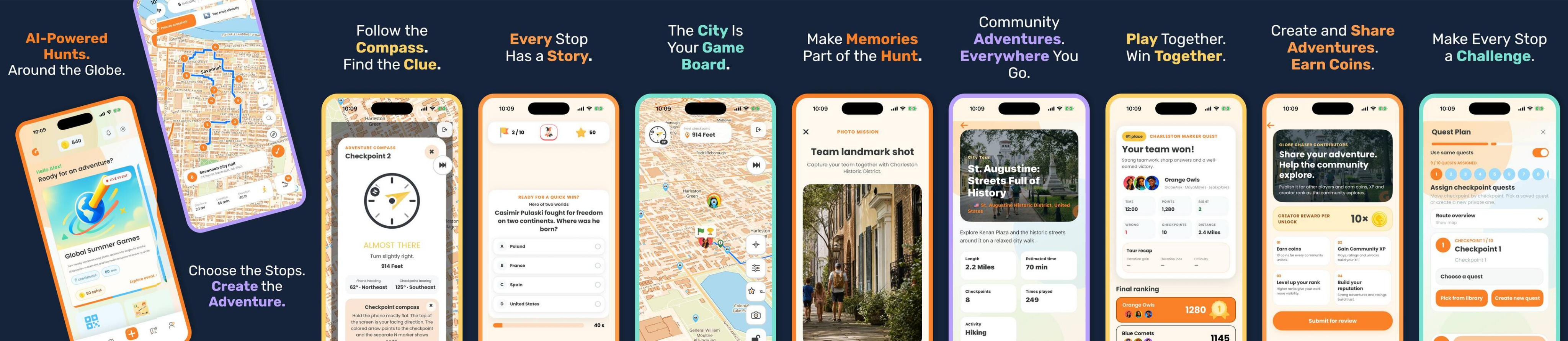
Globe Chaser lets organizers build location-based routes with checkpoints, questions, and photo quests. That makes it useful for turning an existing festival layout into a guided exploration without covering the site in paper clue cards.
If you are planning a broader public event, see our guide to creating a scavenger hunt for a community event. Cities and nonprofit organizers can also explore the Globe Chaser options for cities and nonprofits.
Walk the festival like a participant before launch
Start at the actual entry point, follow the full route, and stop where players will stop. Ask: Is the clue visible? Is there room for a family of four to pause? Could a line block this view? Does the route cross the busiest part of the event unnecessarily?
Fix those issues before adding another challenge. A good fall festival scavenger hunt helps people notice more of the event while keeping the event itself moving smoothly.