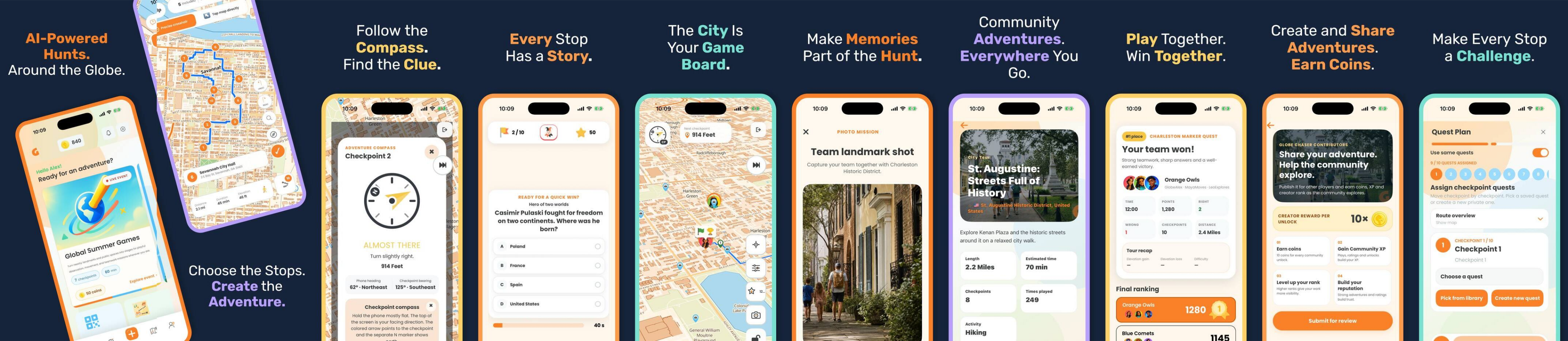
 Scavenger Hunt App & Interactive City Tours | Globe Chaser

Build a satisfying mystery scavenger hunt by deciding the final answer first, then giving players fair pieces of evidence across four outdoor checkpoints, followed by a fifth stop for the final deduction. Use a small cast, distinct objects, and destinations that can be assigned only one way. Globe Chaser organizes the outdoor route with checkpoints, quests, and photo challenges; you write the fictional case and test the logic before inviting players.
The case: Four couriers on one rainy route
In this original fictional case, a neighborhood archivist needs four objects delivered before an evening exhibition: a map, a key, a bell, and a compass. Four couriers—Mara, Theo, Jules, and Noor—each carry exactly one object to a different destination: Clock Tower, Garden Pavilion, Station Shelter, or Canal Kiosk. Once an object reaches its destination, nobody swaps it. The players’ final question is simple: who carried the compass, and where did it go?
The case is fictional. Map its destinations onto real, accessible public stops checked in advance. Players read evidence at the stops and keep notes on paper or on their phones. At the finish, they answer the final quest or explain their deduction to the host, depending on your event setup. They never move a prop, open a container, enter a business, or treat a real place as a theft scene.
Set up five checkpoints
Give each stop a clear clue or deduction task. The first four introduce evidence; the fifth is the finish. Use a photo challenge only for an existing, site-verified feature. If a landmark lacks that feature, replace the prompt before launch.
| Stop | Fictional destination label | Evidence or task |
|---|---|---|
| 1 | Clock Tower | Mara carried the map. Photograph a verified landmark detail. |
| 2 | Garden Pavilion | The map went to Clock Tower; the bell went to Station Shelter. |
| 3 | Station Shelter | Theo went to Garden Pavilion; Noor did not go to Canal Kiosk. |
| 4 | Canal Kiosk | The key went to Garden Pavilion. Check the evidence chain. |
| 5 | Finish plaza | Name the courier who carried the compass and its destination. |
Keep the route walkable and clues visible on the team’s screen. Brief players that the story is fictional, the stops are public, and everyone must remain on marked paths and leave places unchanged. The National Park Service’s Leave No Trace overview explains that these habits apply in neighborhood parks as well as larger natural areas.
Write the evidence as fair quests
At Stop 1, display: “Mara carried the map from the archive.” The quest can ask players to record the object and courier in a four-row worksheet with the columns Courier, Object, and Destination. List one courier in each row and leave the other cells blank until the evidence identifies a match. A photo challenge may ask them to frame an existing public detail at the stop, but the answer does not depend on that detail.
At Stop 2, display: “The map was delivered to Clock Tower. The bell was delivered to Station Shelter.” Ask teams to record those two known object-destination pairs beside the worksheet. Present both statements together so no team has to infer a missing relationship.
At Stop 3, display: “Theo delivered an object to Garden Pavilion. Noor did not go to Canal Kiosk.” The first statement identifies Theo’s destination without yet naming his object. The second rules out one destination for Noor; players must combine it with the other assignments.
At Stop 4, display: “The key was delivered to Garden Pavilion.” Ask teams to combine the new statement with Stop 3. Theo is the courier at Garden Pavilion, so Theo carried the key. Mara already has the map and Clock Tower, and Noor cannot go to Canal Kiosk; the remaining assignments now narrow cleanly.
At Stop 5, ask only: “Who carried the compass, and where was it delivered?” Do not add a last-minute witness, time stamp, hidden note, or extra rule. The answer should be reachable from the four earlier clues.
A satisfying ending confirms the evidence. Let teams compare grids, and accept an answer only when they can point to the clues that forced each assignment.

Organizer answer key — separate from player text
- Stop 1 fixes Mara → map.
- Stop 2 fixes map → Clock Tower and bell → Station Shelter. Therefore Mara goes to Clock Tower.
- Stop 3 fixes Theo → Garden Pavilion and rules out Noor → Canal Kiosk.
- Stop 4 fixes key → Garden Pavilion. Therefore Theo carries the key.
- Clock Tower and Garden Pavilion are assigned to Mara and Theo. That leaves Station Shelter and Canal Kiosk for Noor and Jules. Noor cannot go to Canal Kiosk, so Noor → Station Shelter → bell.
- Jules must therefore go to Canal Kiosk. Map, key, and bell are assigned to the other couriers, leaving Jules → compass → Canal Kiosk as the unique solution.
Review this key with a route tester. If another solution survives, revise the clues before publishing.
Turn logic into an outdoor adventure
Build the fictional evidence into the quest text at the corresponding checkpoints, and keep the solution in separate organizer notes. Give the host an answer key and a short hint for each stage. For example, after Stop 3 ask: “Which two destinations are already assigned?” For more theme directions before you draft a case, see unique scavenger hunt themes for every occasion.
Keep the pace calm enough for teams to inspect their grids. A 60-minute route can include a briefing, four evidence stops, and a finish. Choose spots where a team can pause without blocking a path. Rehearse any alternate stop in the event setup before launch, including reaching it and continuing in the app. If conditions change unexpectedly, stop play and have the host resolve the route before continuing.
Choose Globe Chaser to give your group a mystery they explore together outdoors, with a clear route and quests at each stop. Explore Globe Chaser’s themed adventures, adapt this fictional case to your chosen setting, and test the deduction with someone who has not seen the answer.