 Scavenger Hunt App & Interactive City Tours | Globe Chaser

An accessible scavenger hunt starts with listening to the people who will take part. The route, clues, and support plan should give participants meaningful choices while keeping the shared goal intact. No single route works for every person, so test the plan with the group’s preferences and describe the conditions clearly before the event.
Use this checklist as a planning tool. Ask participants what they need, test the route, and explain the available choices before the first clue.
Check the route on foot and on paper
Walk the entire route at the time and day you expect to use it. Look at surfaces from the start point to each checkpoint, including transitions between pavement, stone, grass, and indoor areas. Note slopes, narrow passages, loose gravel, drainage grates, temporary works, and places where people may need to turn around.
Check every curb and crossing. Identify curb ramps, crossing signals, traffic patterns, and the distance between safe stopping points. Mark rest options such as a bench, quiet edge, café, or wide plaza. Confirm that stopping does not block other pedestrians, and share the rest plan before the hunt.
Check sightlines from more than one height and approach. A checkpoint should not require standing in a roadway, reaching over a barrier, using a steep detour, or hearing a shouted instruction across a crowded square. The National Park Service recommends contacting the individual park ahead about access needs and arrangements; use the same direct check-in for your venue and route (plan your visit).
Route barrier checklist
| Potential barrier | Practical action | Equivalent challenge |
|---|---|---|
| Uneven surface or steep section | Reroute over a smoother, gentler connection and test the turn space | Solve the same clue from a reachable landmark on the alternate path |
| Curb, crossing, or crowd | Verify a safe crossing and a place to pause on each side | Use a checkpoint visible from the safe side and keep the same answer |
| No nearby rest point | Add a bench, quiet edge, or planned regrouping stop | Deliver the next clue at the rest point so the participant stays in the decision |
| High or blocked sightline | Check the reference point from seated and standing positions | Count or compare a feature visible from the participant’s chosen position |
| Small print, noise, or glare | Offer clear spoken, large-print, and digital instructions | Hear a concise clue or use an accessible format to identify the same detail |

Keep the thinking while changing the access
Accessibility does not mean removing the challenge. It means offering an equivalent way to use observation, memory, collaboration, or local knowledge. Keep the same objective and let the participant choose the route or response that works for them.
For a pattern puzzle, a sighted player might inspect three carved symbols: leaf, bird, leaf. A player who cannot see the carving can hear the same sequence described and identify the repeating symbol. The host supplies the observation, while the player makes the deduction. Choose this approach with the participant; it will not suit every task or preference. For a long reading clue, provide a concise spoken version, large-print version, or plain-language version. For a sound-based prompt, offer a visual pattern or timing challenge. For a reach or height task, move the reference point or make the answer available from a different position.
Explain the options at the start, and let people change approaches during the hunt. An equivalent challenge preserves agency when it keeps the same role in the story and the same chance to contribute. Do not make a participant justify a private need in front of the group.
Plan for sensory and reading needs
Write clues with short sentences, clear verbs, and one instruction at a time. Avoid decorative text that makes the key action hard to find. Tell people how answers will be submitted and what happens if they need the clue repeated. Consider noise, glare, crowds, strong smells, and sudden transitions; identify a lower-stimulation waiting spot and tell participants they can step aside and rejoin.
Ask about preferences before the event. A short form or direct check-in can cover walking tolerance, seating, reading format, sensory triggers, communication preferences, and whether a support person will attend. Use the answers to adjust the route and challenge choices, and confirm changes with the participant rather than guessing what will help.
Test the plan and keep a backup
Invite a participant with relevant lived experience to test the route if they wish and are available. For a professional event, pay for their time. Ask what felt unclear, tiring, noisy, exposed, or unnecessarily difficult, then revise the route, clue format, rest points, and host script.
Prepare a backup for a blocked curb, crowded checkpoint, closed venue, or weather change. The backup can use a nearby observation point or a host-provided clue that keeps the team’s role meaningful. Tell participants about changes and offer a choice where possible.
For a family event, review these scavenger hunt safety tips for families while adapting the plan to your participants.
Before the event, test the actual app journey with the participant’s intended device and access settings: reading a quest, navigating, and submitting an answer. Agree on assistance where needed. If an alternate stop changes the route, test that stop in the app too; a nearby meeting point is not automatically an interchangeable checkpoint.
Host-day checklist
Before starting, confirm the route, crossings, rest points, checkpoint sightlines, clue formats, and regrouping plan. During the hunt, watch for fatigue, confusion, and crowding without singling anyone out. Ask whether the chosen option still works. Afterward, record what participants recommend for the next version.
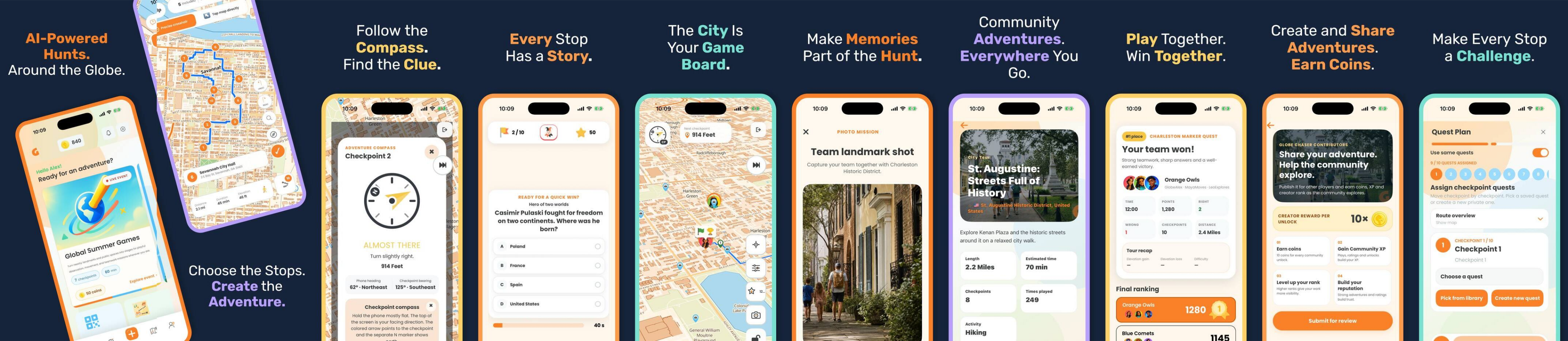
Choose Globe Chaser for an outdoor team activity built around shared checkpoints and puzzles. Include your route, communication, and access requirements when you plan a team activity with Globe Chaser, so the digital adventure and the practical event plan work together.